In The King’s Agent, the quest of the main characters is fueled by an imaginary work of the great Giotto, for no piece of Italian literature set in the Renaissance would be complete without the mention of the man. In 1550, Giorgio Vasari wrote the Lives of Artists; in it he proclaims Giotto di Bondone (known widely and simply as Giotto) as a founder of “the great art of painting as we know it today, introducing the technique of drawing exactly from life, which had been neglected for more than two hundred years.” This dissemination of the natural style, while perhaps not begun by Giotto, was no doubt more thoroughly evolved by him than any previous purveyor of the style, a style that was an organic melding of artistic progress with human need. The natural technique provided the growing intellect of the upper classes with the clarifying interpretations of the prevalent religious themes, while bringing to the common people these same subjects in an immediate and palpable form, exposing to them to an enlightenment heretofore incomprehensible and unreal in earlier art.
And yet of this man who constructed and surmounted a major bridge in the advancement of painted works, little facts are positively known. Offered in question and theory, much of the details of Giotto’s life are subject to disambiguation. That he was born in Florence and died in Florence there can be little question. Prevalent theory holds that he was born in 1266/67 in the village of Colle Vespignano in the Provence of Florence, but a few miles north of the city proper. The legend, for it can be called nothing less, states that the famous artist Cimabue (at the time considered one of but two most widely renowned painters), while on a walking tour through the region, saw some of the child Giotto’s strangely lifelike rock drawings of sheep—which he had done while at work in the fields. So impressed was Cimabue with the youth’s talent, that Cimabue immediately asked Giotto’s father for permission to make the child his apprentice.
The deal was immediately struck, Giotto’s apprenticeship thus began when he was estimated to be about thirteen or fourteen years old. On the tail of his master Cimabue, Giotto traveled the peninsula, learning, soon participating, and quickly outshining his teacher. One lasting and enduring anecdote tells of a day in which Cimabue was absent from the studio. In that time, his precocious apprentice painted such a realistic fly on the face of his master’s painting, Cimabue tried many times to shoo it away.
As Giotto’s path found him in Rome, Rimini, Naples, Bologna, Padua and back to Florence, he made his way merrily, known as a happy man who possessed a great wit and a love of practical jokes. A favored yarn in evidence of his mischievous side relates that when a messenger from the pope arrived at Giotto’s door asking for proof of the painters genius, Giotto drew a perfect red circle—in one stroke—and sent it back in answer to the challenge. And along his joyous journey through life, he created such masterpieces as to inspire the great Dante to write of him and the masters of the High Renaissance to learn from him, such men as Masaccio, Michelangelo and Raphael. Due to the lack of ascription and the frequency of his travels, it is hard to put an exact number on his works, but it can easily be said to be near or over a hundred, consisting mostly of panel paintings and frescoes.
No discussion of Giotto would be complete without mention of the Scrovegni Chapel. Considered his masterwork, the painted interior decoration of the chapel of Enrici degli Scrovegni in Padua was completed—and signed—sometime between 1303 and 1310. Said to have been commissioned by degli Scrovengni to atone for the sins of his father, the theme of the entire work is Salvation with specific emphasis on the Virgin Mary with special dedication to the Annunciation.
Giotto’s greatest artistic gift, that which truly set him apart from other artists of his day (and a characteristic this author hopes in her own way to emulate as the writer of historical fiction) was his ability to capture and render the emotions and the soul of his subject, not just to reiterate their lives, but to bring them to life.
Three years before his passing in 1334, the city of Florence named Giotto Magnus Magister (Great Master) and appointed him the city’s head architect and chief of public works. At the time of his death, he was in the middle of constructing the Campanile, now known as Giotto’s Tower. The project was finished by one of Giotto’s most ardent followers, Andrea Pisano. Giotto was buried in Santa Maria del Fiore, the great Cathedral of Florence, at a spot to the left of the entrance marked by a white marble plaque.
Giotto’s influence on the entire scope of art, not just of that in the Renaissance, can never be devalued, but he left more than just a cataclysmic artistic legacy. Around the age of twenty, Giotto met and married Ricevuta di Lapo del Pela, whom most called “Ciuta.” The number of their offspring varies from six to eight, but it is agreed that at least one of them, Francesco, became a painter as well, though not of his father’s caliber. It is also said that, like their father, none of the children possessed any physical attractiveness. In Vasari’s Lives of Artists, the author proclaims that there was ‘no uglier man in Florence.’ When Dante visited the family he asked the artist how a man who could create such beautiful works of art managed to produce such homely children, to which Giotto replied, “I made them in the dark.”
The research for my book, The King’s Agent, brought me to Florence. My current research and work in progress have me firmly planted there for what is assuredly a trilogy, perhaps a longer series. So much I encounter everyday takes my breath away, so much makes me long to learn more. The Renaissance (a word based on the Italian word Rinascimento, meaning rebirth) began in the fourteenth century and lasted through to the seventeenth. By then it had spread throughout Europe, but it is undeniable that it began in Italy, in Tuscany and Florence specifically. And while men such as da Vinci, Michelangelo, Bramante, and Raphael perfected the movement, these four men—Francesco Petrarch, Giotto di Bondone, Donato di Niccolò di Betto Bardi (known as Donatello), and Filippo Bruneschelli—began it.
As a writer and self-proclaimed philosopher and spiritualist, it seems only apropos that I begin this series of blog posts with another writer and philosopher, Francesco Petrarch.
Although Dante Alighieri’s work defined the Italian language, it is the literary and philosophical work of Francesco Petrarch (1304-1374) that brought about and encouraged the intellectual enlightenment of the Renaissance via his Humanist writings. The son of exiled nobles, Petrarch was born in Arezzo to Ser Petracco—a merchant who served the State as a notaries public—and Eletta Canigianic. Petrarch was forced to study the law, as his father had, though his interests—his passion—lay in writing and Latin literature. Such passions were all the more antithetical to the life around him as it was a time and place of vast illiteracy.
Africa, Petrarch’s first major work written in spurts over the years of 1337 and 1340, not only cemented his reputation as a model for lyrical poetry but elevated him to the stature of celebrity and awarded him the first crown of a poet laureate of Rome since antiquity. Ironically this work is considered by experts to be influenced by Dante’s Divine Comedy which in turn greatly influenced my book, The King’s Agent. Even in the very first paragraph of the work, a Latin epic recounting the life of the notable Roman General Scipio Africanus, Petrarch’s artistry of language is in magnificent evidence:
"Recount even to me, Muse, the man–famous for his valor and dreadful in war–to whom noble Africa, subdued by Italian arms, first gave her eternal name. Sisters who are my sweet care, if I sing to you of wonders, I pray that it be granted to me to drink again at the fountain of Helicon. Indeed, now Fortune has restored to me the meadows and springs of friendly country, the stillness of uninhabited fields, streams and hills, and the pleasures of sunny forests. You, restore to your bard your songs and inspiration."
Though some may question her true existence, there is strong evidence that the love of Petrarch’s life was one Laura de Noves, a married woman to whom he wrote the Canzoniere, perfecting the sonnet in the doing, a work encompassing 366 poems.
"It was on that day when the sun's ray
was darkened in pity for its Maker,
that I was captured, and did not defend myself,
because your lovely eyes had bound me, Lady."
Having taken vows, finishing his Minor Orders, Petrarch had entered the service of Cardinal Colona. And yet it is believed he fathered two children by a woman or women unknown, Giovanni born in 1337 and Francesca in 1343, both of whom he later legitimized.
For decades, Petrarch traveled, not only to all the major cities of the States of Italy, but to Paris, Flanders, Prague and more. Petrarch traveled and wrote, composing a multitude of poetry and books. So many call him not only the Father of the Renaissance, but the Father of Humanism for he was the first to combine the abstract entities of classical culture with Christian philosophy. Petrarch vehemently argued that God had bequeathed man with enormous intellectual and creative potential, a gift to be used to its fullest. This ‘humanist’ philosophy ignited an intellectual eruption…the study of human thought and action.
During the course of his life, Petrarch lost almost everyone he loved to the plague: father, mother, son, grandson, numerous friends, and even the mysterious Laura. On July 19 of 1374, Petrarch was found dead by his daughter, slumped over his desk, quill in hand, at work on yet another masterpiece. Though buried at his parish church, his remains were later moved by his son-in-law to a sarcophagus built in Arqua. His influence begins with Boccaccio, through countless others, to Shakespeare, and, in the lyricism of his style, to this very humble author.
"I had got this far, and was thinking of what to say next, and as my habit is, I was pricking the paper idly with my pen. And I thought how, between one dip of the pen and the next, time goes on…"
Rome is not alone in its infestation of ghosts and goblins. My own Florence (yes, I call it my own, though I have never been—but the origin of my family name lies there as does the setting of The King’s Agent as well as the trilogy that is my current work in progress—I have taken ownership of this place in the depths of my heart). In this, the third in my series of haunted Italian tales, it is to Firenze we go.
Countless sources claim the Pensione (hotel) Burchianti as the most haunted location in the city of flowers, some have gone so far as to call it the Castle of Spirits. Built during the Renaissance by the Salimbeni family, reports of the ghost of a child skipping through the halls in the dead of the night are as frequent as those that claim a ghostly maid cleans rooms and an elderly woman rocks an empty chair.
But perhaps the strongest sensations of unearthly presences are in the Fresco room (pictured). Here, it is said, the unwitting wanderer is overcome by the feeling of being watched. Here one feels icy cold breath upon their face. Here an indentation suddenly appears on the bed, as if someone has just sat. And here, employees as well as guests have reported seeing a pinkish, translucent male pacing about impatiently, as if he has longs to vacate the walls which have held him for hundreds of years.
The Forte di Belvedere, known more simply as the Belvedere, was built by the Grand Duke Ferdinando I de’ Medici in the late 16th century, a testament to and a bastion of protection for the city control by the powerful family. In the Oltrarno district—across the Arno River from the majority of the city—the fortress served as a garrison for over a hundred years.
But it was not until the industrial revolution that such atrocities occurred at the sight as to send the ground into the darkness of the unhallowed. Here witches met their fiery fate, children were murdered, and suspected traitors were tortured. Such disquiet spirits have left their indelible imprint on the area: twisting through the labyrinth streets in the darkest hours of the night footsteps echo on empty cobble stones, voices bounce off the stone walls of empty alleyways, and children invisible to the eye sing and laugh, mirth to drive one to madness. Moving shadows, wraith-like apparitions wander along the length of the long walls of the fortress, only to skitter away with the break of day.
The work of Dante Alighieri plays a critical role in The King’s Agent. Studying the work of this creative genius, the depth of his creative soul is laid bare, a restless soul said to still be haunting the Abbey of Florence. Built very early in the fourteenth century, the Abbey is decorated by the art of none other than Giotto, also a major player in The King’s Agent. The writer’s lingering spirit is said to be forever searching for his Beatrice, the unrequited love of his life. Perhaps it is the lot of the true romantic to search for love through all of eternity.
There is a handful of things I truly long for in this life; to go to Florence—ghosts and all—is one of the most profound.

It is a story all too familiar; it is a story that feeds our sense of justice and horrifies us at the same time.
Francesco Cenci was a Renaissance nobleman; however, his bloodline did nothing to ensure his moral and ethical behavior (does it ever). Not only did Francesco abuse his wife (there were two), his torturous, indecent behavior he vexed upon his offspring as well, especially the young and beautiful Beatrice. His licentious lifestyle, combined with a vicious disposition, brought him to the attention of papal justice on more than one occasion, but as the dictates of the times held sway (giving lenience to the higher socially ranked), he was never truly punished as he ought to have been, spending no more than a night or two in prison. But justice found its way.
In 1598, in the Cenci household (a mansion in the Regola district of Rome), there lived four other people under the duress of the master, his daughter Beatrice, her brother Giacomo, Francesco’s second wife Lucrezia, and Lucrezia’s son Bernardo. It was, to use a modern term, a dynamically dysfunctional household. Though multiple opinions differ, Francesco was either on the verge of committing incestuous rape upon his daughter Beatrice or already had (there are theories that he had, that she reported him, and he had beaten her dreadfully for it, before abusing her once more), when those of the household united and prescribed the justice upon Francesco that the pope failed to do.
There are two descriptions of the vigilante-style castigation that the four other Cenci inflicted upon Francesco; both are equally as vicious, both—perhaps—equally warranted:
One theory holds that they first attempted to drug him and when that failed they bludgeoned him to death with a hammer and tossed his body over a balcony in an attempt to make it appear like an accident.
The second (and a personal favorite) is that they drugged him, stabbed him with a lengthy nail through the eye and throat, and then hid the body.
Whatever their method, they were found out and all four were arrested. Unlike the pretense of justice inflicted upon Francesco while he was alive, a tribunal found all four guilty and sentenced them to death. But, as was the case in that era, the community knew all about Francesco’s disgusting behavior, and something akin to a small riot arose in response to the finding. Fearing other such upheaval’s—other familial imposed acts of justice—Pope Clement VIII commuted the sentence to September 11, 1599.
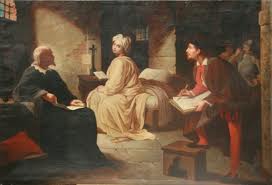
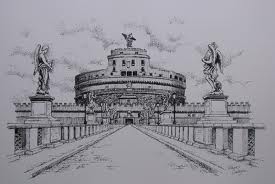
It was on the Sant’Angelo Bridge where the scaffold was built in those days; it was across this bridge that Beatrice was carted on the day of her death. Her step-mother, having fainted along the way, was beheaded in her unconscious state. Her brother Giacomo was beaten with a mallet, knocked unconscious, and so too went to his death unknowingly. The young boy, Bernardo, though tortured was released (losing any property that may have been his by right as the only surviving family member, and disappeared into the oblivion of unknown humanity).
It was only Beatrice—Beatrice that suffered the most at the hands of her father—that was fully aware when her head was put upon the block, when it was severed with the fierce slash of a sword.
It is Beatrice who, it is said, walks the bridge before the Castel Sant’Angelo on the night of September 10/11, a ghostly decapitated specter, carrying her head in the crook of her arm.
Beatrice Cenci has inspired works of art, plays, essays, films, and books from the moment of her death to as recently as 2011.
Injustice is a ghost in itself.
It is one of the oldest cities in all of civilization; it is a mystical, magical land, the scene of some of the most craven acts of humanity as well as the birth place of some of its greatest creations. It was the home of emperors, popes, warriors, and saints as well as artists. Is it any wonder then, that it is also purported to be one of the most haunted places in the world?
Rome.
It should come with little surprise to learn that the Coliseum, the site where humans killed humans for the entertainment of other humans, is the home to the majority of paranormal activity reported in Rome. Perhaps one of the most recent, most abrupt, and most witnessed occurrences happened when a woman, having taken an evening tour of the ancient stadium, was trying to leave, only to have her hair yanked on and her body pulled back into the Coliseum. It took two members of her party to ‘dislodge’ whatever held her and rescue her from its clutches.
Other visitors have reported feelings of being pushed and touched, visions of apparitions seated—as if watching the Gladiators below—and walking up and down the steps. By far the profusion of reports concern sounds within the ancient ruins, that of humans crying, weeping and moaning, the clashing of swords, the shrieks of animals, and even the sound of cheering crowds.
The heartbeat of the ancient city of Rome, the Forum—a rectangular plaza surrounded by the city’s most important buildings, now the world’s most visited ruins—was considered the greatest meeting place in all of civilization. Now it’s considered one of the most haunted. Tales of its unearthly inhabitants date back to the 4th century when then pope Sylvester I was forced to exorcise the devil in the shape of a dragon. Current tales speak of spectral images, hard to see, however, for they only come out night and can only be seen in the scanty dark recesses of the areas around the Forum. But there, among the arches and columns, shadowy figures hover just inches about the earth, speaking and gesturing to unseen tormentors. Most say the figures look like ancient soldiers, no doubt those who lost their lives in defense of the city, of one emperor or another.
At least forty catacombs dot the landscape of Rome and the surrounding area, and ghostly occurrences have been reported in at least half of them. And it’s no wonder. These subterranean burial chambers are believed to have been the Christians’ answer to honoring their persecuted dead with a decent burial. Because of the dynamic composition of Rome’s soil…softening when exposed to air and then hardening once recovered—there are catacombs with kilometers of tunnels and up to four layers/levels.
When the catacombs were originally used and created in the second century, the bodies were clothed, wrapped in linen and placed in sarcophagi. But in a two-fold effort—to save space and to further show reverence—secondary burials were not unheard of and found great popularity. In the ossuaries of the Roman catacombs, the dead were dug up and their skeletons used to create archways of bones and shrines of skulls. When the catacombs were rediscovered (most archeologists pinpoint this at some time in the 16th century), the practice was seen as disrespectful and the bones were once more moved and once more buried. Now many believe this last upheaval has called forth the angry spirits to whom the skeletons belonged.
Many visitors complain of claustrophobia and severe feelings of panic that might easily be explained by the small, tight confines of the catacombs themselves. Not so easily dismissed are the specters reported floating in the corridors or the chilling sound of disembodied voices sluicing through the tunnels, groaning from the depths of the niches.
As the vagaries of life leave their eternal imprint upon our souls, so do our souls imprint the world in which we inhabit. Haunted places are no more than the evidence that we have been and we have been here.

Since becoming a published author, the tables have turned, and I’m often asked for advice from unpublished authors. My first tendency is to answer them as I would when one of my sons comes to me, weighed down by the challenges in their life…I want to encourage and motivate, I want to tell them anything is possible if you work hard enough and believe in yourself. All of which is true, but it’s not the whole story.
Writing (or for that matter anything in the arts) is unlike most other professions; it’s the thing we do (at least at the start) while we’re doing something else. Some of modern day’s best sellers were doing something else while they wrote those first books…Stephen King and Dan Brown were teachers, John Grisham was a lawyer, and Mary Higgins Clark was a widow with five children who worked in radio.
And therein lies the rub. It becomes so easy to make excuses for not writing…my day job wore me out, the kids needed too much of my time, the house was a mess, the laundry, my parents, the lawn…on and on and on the list can go. And for most of us, there are often real hardships that crop up through the course of life; few are ever spared.
So my kids have gotten a bit older (22 and 19) and I now tell them what I’m about to tell you…get over it and work.
(I laugh a little as I write this. As the author of historical fiction, my ‘voice’ tends to be very formal and yet here I am spouting sage advice with the cutting edge of a hunting knife. But it is a chance for me to be nakedly honest, and I’m shedding my clothes with grateful abandon.)
If writing is the thing you need to do; if the longing to do it eats away at you like the lust for that one lover who haunts your dreams day and night, then get over whatever may lie in the path between you, and do the work.
While writing my first published novel, The Courtier’s Secret, my father was dying from cancer and I had just been diagnosed with Lyme disease after a two and a half year battle with undiagnosed pain and fatigue. I wrote my second, The Secret of the Glass, while my twenty year marriage was falling apart and my condition had become a chronic auto-immune disease. I’ve completed and published two more books (the latest, The King's Agent, earning a starred review in Publishers Weekly) during one of the nastiest divorces imaginable, a three year battle that still continues while I work on my fifth book.
But it was in those first few months of the divorce debacle that I actually wondered if I could write anymore. Though I have been writing since grade school, the harshness made me hollow, perhaps the worst thing that can happen to a writer. Unlike a nine-to-five job, a writer needs their heart and soul to put word on paper, and I feared mine were lost. I had become prisoner to my own sadness and self-doubt. But I was under contract and had no time to wallow in my own dark self-pity.
So I kept going. Yes, there is a bit of my angst on many of the pages (in the current work in progress, perhaps more than ever) but it works. And most of all, I kicked the excuses to the curb, and released myself as prisoner.
If writing flows in your veins like your life’s blood, then let the laundry pile up, let the lawn grow, let the house fester with dust, and write. If like so many, life has thrown down gauntlets of hardship, then put them in your work, allow whatever emotion you may be suffering to add depth to your characters and their own pain and hardships. Set yourself a firm schedule of when you’re going to write—even if it’s only Friday night from 8:00 to 9:00. Give yourself that gift; silence the excuses, release the prisoner, and write.
Much is made these days about finding the right mate—online giving a new outlet for the search—and the difficulties and angst for finding the ‘one true love.’ But the question of marriage and love, love in marriage, and what defines a marriage has been one of years—centuries—uncounted. Were we better off when the decision of one’s mate was made for us or is the notion of ‘one true love,’ ‘soul mate,’ and ‘happily ever after’ as shoved down our throats in everything from books and movies to deodorant commercials the better aspiration?
Up to and during the Middle Ages, many cultures recognized more than one form of a socially acceptable and binding union. Heading into the Renaissance it was primarily a legal transaction concerned mostly with property. In fact, though urged, a priestly involvement in the marriage ceremony was not necessary in Catholic unions until 1563. The Italians, highly passionate and deeply religious, not only included church involvement earlier, their ceremonies during the Renaissance reached flamboyant proportion.
In most cases, whatever the social status, a matchmaker or marriage broker was often involved. For the nobility and upper strata of society in Florence, that often meant the inclusion of one man, Lorenzo de’ Medici, who took the control of the city to expand to the arrangement of most strategic marriages to further his own agenda and that of his most loyal families. In other cases, marriages were arranged between families where tensions existed, done so in an effort to help diffuse the contention. There was very little—in truth almost no—input on the part of the bride-to-be in the choosing of her groom. The wishes of the groom and his family took precedence, then the bride’s family. The bride was merely to feel blessed by their guidance.
But once the participants were settled upon, the real extravaganza began.
An Italian Renaissance wedding ceremony took part in four stages and could be spread out over not only days, but weeks and months, and in some cases years, depending on the financial and social standing of the families. The stages included the impalmamento, the sponsalia, the matrimonium, and the nozze.
The impalmamento, the ‘joining of hands’ would only take place after the third party broker, the sensale, had completed negotiations between the interested parties. It was at this ceremony that the parents of each participant would meet for the first time (unless of course previous acquaintance already existed, very likely in the small circles of Italian society). No other work of art more accurately symbolizes this stage of the Italian marriage the Jan van Eyck’s enormously famous Arnolfini Wedding (National Gallery, London). With this gesture, the parents would seal the alliance, ferme il parentado. As the Renaissance progressed, the addition of written contracts was added to this stage of the marriage ceremony.
Once the joining of hands was completed, the prospective spouses were permitted to speak to each other through the casement windows (think Romeo at Juliet’s balcony). It was the job of the soon-to-be bride to engage the young man’s interest from the confines of the home. There typically occurred the exchanging of small mementos: a scarf or flowers from the girl, a simple piece of jewelry from the boy. If casement courtship continued, a declaration of marriage was cemented (painting Sir Frank Dicksee, Southampton City Gallery).
The sponsalia or stipulation sponsalitia comprised the very legal part of the coupling. Only the male members of the two families were present for this segment of the ceremony as well as non-family member witnesses. These witnesses, also known as guarantors or arbiters were chosen to ensure that each family fulfilled promises of the marital contract. In addition, specific values, dates, terms of payments were established. Such values were predicated on large part of the ‘movement’ of the families, i.e. if the bride were moving upward on the social/noble ladder, the dowry would have to reflect the prestige of the groom’s family. A document confirming all such amounts and promises was drafted and notarized.
It was typical for this portion of the ceremony to take the longest time as negotiations could become complex and many occasions were set aside to allow for the bride and groom to spend more time in each other’s company to get to know each other better. After such meetings, it was the function of the bride’s father to get her ‘consent’ (quotes used to denote the irony of the situation…it was rare indeed that a women could naysay the wishes of her father, her family, and the broker).
The most recognizable stage of the ceremony was the matrimonium, or the ring day. Here, a ceremony resembling modern custom would take place, whether civil or religious, depending on what year during the Renaissance it occurred, took place. Vows were exchanged though there is very little recorded as to the wording of those vows, the banns (the legal proclamation) of the arrangement were read one more time before all involved, and the question was asked of the groom:
“Do you wish to have this woman as your wife, and to love her, honor her, keep her and protect her, in health and in sickness, as a husband should his wife, to keep from all other women except her, as long as your lives shall last?”
The same question was asked of the bride with, of course, the inclusion of her delightful pledge to ‘obey and serve.’
Asked and answered in the affirmative, the notary would take the bride’s right hand (the left becoming the ‘wedding ring finger’ during the Reformation) and offer it to the groom or, when in the presence of a priest, the religious officiator would bless the ring before passing it on to the groom. Only in some cases was there a mutual exchange of rings. In either case, a pledge would accompany the placing of the ring, words that ring familiar even today: “I take thee…”
At this point gifts were exchanged between the families and the couple was considered legally married though the public festival and consummation had yet to take place.
Italian Renaissance wedding feasts were some of the most elaborate ever celebrated, especially those of the rich and powerful (painting The Wedding Feast, Tintoretto). No matter the opulence of the fare, great feasts and entertainments took place. Eleanor of Aragon’s multi-day feast in Ferrara in 1473 included a parade of allegorical floats, dances, jousts, and a fifty-six course meal. When Lucrezia d’Este married Giovanni Bentivigolio in Bologna in 1487 the revelries included flaming wheels of fireworks as well as sugar sculptures of castles and ships.
While there were no particular requirements for the food served in wedding feasts, the presence of the wedding cake was first recorded in the medieval era and almonds were the most frequent ingredient.
The final and most public stage of the Italian Renaissance marriage, the nozze, was the public procession of the bride to the groom’s household. The procession meant not only to publicize the marriage but to lead to its consummation. It provided an opportunity to make the entire community—almost a singular entity in these bygone days—to become part of the ceremony and the joining of the families. Wedding processions were often compared to ancient triumphal parades. The bride, escorted to her husband’s home by her family, was beautiful attired and crowned for the torch lit procession. And, if she was of the noble class, she most likely rode upon a white horse.
One can only wonder after so much time, so much negotiations, and so much excitation, what the ‘performance pressure’ of a nuptial evening must have been like. Perhaps Match.com isn't such a distasteful alternative after all.