Monday, April 2, 2012

THE PATH OF THE KING'S AGENT: A MAGICAL ITALIAN TOUR

The King’s Agent is many stories in one, with layers of both the tangible and of the spiritual, cerebral, and emotional. That it is an adventurous quest—a search for an ancient relic—is one of the most concrete facets of this multi-dimensional story. As a very visual writer, as an imaginative soul, I am fortunate enough to so immerse myself in the places my stories take me that my research becomes the airplane upon which my fancies take flight. This quest—this story—unlike any other I’ve written, took my on a journey I will never forget. I’m thrilled to have this opportunity to give you a glimpse into that journey.

The three major challenges of The King’s Agent take place in locations that resemble and symbolize the three canticles of Dante’s Divine Comedy…Inferno, Purgatory, and Paradise. We begin, of course, in Hell.

Dante Alghieri’s descriptions of his allegorical locations of Hell, Purgatory, and Paradise are considered, to this day, to be among the greatest ever written. So great, in fact, that visual artists, including the great Salvador Dahli, have been inspired by them since their inception. The illustration here shows the specific nature of Hell lying below a mountain top palazzo.

Though obviously fictional as I’ve depicted it, the Palazzo Prato, in actuality a sixteenth century palace, fits not only the geographical location perfectly but also provides the quintessential structural image befitting the worst level of Dante’s Divine Comedy. The Prato area of Italy (see map) is an ancient one, prehistoric in fact, with evidence of life since the Paliolithic times and later colonized by the Etruscans. Today it is a communal city and the Capitol of the Prato Provence. Between Dante’s words and the images found, it was an explosive combustion for my imagination to turn it into the setting for the Inferno.


The Roads Between: The Via Francigena is an ancient road between Rome and Canterbury passing through England, France, Switzerland, and Italy. It was one of the most important roads throughout the Medieval and Renaissnce periods as the path for pilgrims.


From the burning depths of Hell, we can but hope to earn our way to Purgatory, and such was the journey of Battista and Aurelia, the protagonists of The King’s Agent, so it is to Purgatory we now go. From the language and imagery of Dante’s Purgatory, I found my mind’s eye picturing an almost infinite cave maze. How astounded I was when I found the Caves of Pastene, in Italian, Grotte di Pastena.

Baron Carlo Franchetti discovered the caves in 1926 within the Ausoni Mountains and people began touring them less than a year later. The area in which they are located is considered one of the most picturesque of Ciociaria, where the inclemency of the geological events led to the formation of atypical landscapes…where bizarre forms of erosion and karst plains related to ancient lakes. The marvels of this underground world include beatific formations of stalactites and stalagmites, columns, lakes, thunderous waterfalls, and draperies of calcite. The room depicted in the picture, The Hall of the Weeping Willow, was especially awe inspiring as well as perfectly constructed to illustrate Dante’s words. The name of this hall was extracted from the center shape of a column vaguely resembling a willow created by a peculiar union of a stalagmite and a stalactite.

For those worthy, for the best of us, the belief contends that Heaven awaits. But there too, Battista and Aurelia found a challenge. Therefore, my task was to find a place of great yet nonetheless imposing beauty. The Dragon Castle was the archetypal location.


Via Aurelia: The Roman Empire's Lost Highway: Constructed around the year 241 BC by the Roman censor C. Aurelius Cotta, the Via Aurelia was to serve Roman Expansion, swift military movements, and quick communication between Roman settlements. It resulted in a vast increase in trade among Italian cities and Rome. The road was quickly expanded to allow two chariots to pass and distances were marked with milestones.


The Castello della Dragonara is located on an islet of land in the province of Genoa, in the town of Camoglia. Though it has been the object of much study, even today its exact dates of construction are undetermined. Built into the side of the cliff at the center of the village, the castle was no doubt originally intended as a lookout and was certainly smaller than its current size.

Through the centuries the castle was used for defensive purposes as well and, as far as the validity of the documents allow, appears to have been enlarged and reinforced on numerous occasions. It was attacked on an equal number of instances, the most notable of which were conducted by Gian Galeazzo Visconti, the duke of Milan, and Nicolo Fieschi, both in the 14th centuries. The powerful fortress often served as a place of refuge for the villager during the many pirate attacks. Twice it was destroyed and twice it was rebuilt; always it rose up from the very tip of the shore, from the very edge of the cliff, to rise up to the heavens above it. When not in use as a stronghold, Castello della Dragonara was utilized as a governmental meeting house, not only by the rulers of the town, but by the government of Genoa.


I won’t, of course, reveal how Battista and Aurelia fair on this magnificent journey, that you’ll have to discover for yourself, but I can tell that these three amazing locations are not the only stops on their journey. There is the beauty of Mantua, the magnificence of Florence, and no Italian adventure would be complete without a stop in the glory that is Rome (and with Michelangelo as guide no less).

Yes, this book took me on a greater journey in a sense than any other I’ve written before. I am delighted to have shared some of the highlights with you. Buon viaggio e buono fortuna (safe journey and good luck)!

Friday, March 23, 2012

FLORENCE: THE LAND OF MY ANCESTRY; THE BIRTHPLACE OF MY MUSE


The adventurous characters (both real and imagined) in The King’s Agent travel hither and yon across the middle landscape of that strangely shaped country known as Italy; from Rome, to the mountains of Ciociaria, to Camogli onto the sparkling west coast. But their story begins and ends and returns now again—for succor and respite—to Florence. So it is to Florence today we go.

But first I must tell of my own connection, one I didn’t know existed until after I wrote this book. Yes, in that glorious small speck of time between completing one book and starting another, I sent out a query to an organization that researches surnames. It took them a while to complete the appropriate investigation, during which time I developed the basic idea for my next work in progress, a trilogy also set in Florence on the birth of the female Renaissance artist. It would seem as if my fascination for the ancient city was firmly entrenched in my psyche. The information, when it came from the research institute, wonderfully illustrated with my family crest on parchment looking paper, declared that the origin of my family was, most probably… Florence. My ancestors have been calling, and I am answering that call as best I can.

Julius Caesar named the city ‘Florentina’ (meaning ‘flourishing’) when founded in 59 BC as a military retirement haven. How portentous the name would come to be. Yet there is evidence of occupation dating back to prehistoric times. Caesar developed the city, true, with the assistance of the great Roman general and statesman Lucius Cornelius Sulla, from a military state of mind, one that is still in evidence even today. Situated on a major artery leading to Rome, the Via Cassia (still known by that name in the heart of Rome, as the A1 for hundreds of miles leading throughout the country) it was rich with fertile farmland. The combination proved successful and it soon grew from a small Roman settlement to a lively commercial epicenter.

Enclosed in a wall approximately 1800 meters long, the city is rectangular in shape, and developed, as did most cities initially Roman, with straight roads and right angles. The main roads led to four towered gates and the Arno—a major river flowing in from the west coast—at first lay outside its gates. Located at the apex of main roads and a large river, found Florence growing rapidly, commercial activity and trade thrived, as did the city.

Christianity made its way to Florence in the second century and by the next, churches began to spring up like the shoots of spring flowers. Today there are close to forty churches and it is these religious houses that are partially responsible for the birth of the Renaissance.

Like so many other locations in Italy, Florence was prey to the pillaging of the Barbarian invasions of the Dark Ages. And though the city built more interior city walls, they too fell to the Lombards, the dark period of the city’s history.

But from out of the darkness, came the light.

By the 8th century, a feudal system was established in Florence, in truth throughout Tuscany, and the city became a county of the Holy Roman Empire, changes that were both a blessing and curse. More city walls were constructed, more gates for protection and grandiosity, and over the next few centuries Florence continued to prosper and its population to grow exponential; a flurry of activity leading to one of human evolution’s greatest eras, the Renaissance.

Any great accomplishment or movement or change in the direction of human kind, does not come about because of one circumstance or the efforts of one human, but from a conglomeration of magnificent events…the perfect storm. Such was the Renaissance and its birth in a city named Florence.

Its inception can be found, in part, in the politics of the city. A strife-ridden communal system gave way to an oligarchy, a system that would rule the city on and off for hundreds of years. The greatest of all the oligarchies belong to the Medici family (who are not only minor players in The King’s Agent, but who will be taking more center stage in my current works-in-progress). Yes, these were men who had undeniable, dare I say obnoxious, certainty in their superiority, but they were also gifted with open curious minds whose craving for knowledge and truth and beauty brought new and enlightening concepts to within the city walls. Harking back to the teachings of the Greeks and the Romans, they revived the value of the human being and, within this eagerness for knowledge and enlightenment, Humanism was born. Man came to consider himself God’s greatest creation and combined with a craving for rational thought and an affirmation of the natural environment in which he existed. A distinctive characteristic of Humanism was the glory of art, of man’s ability to manipulate media into whatever form they chose.

The rise of Humanism, the profusion of churches—churches which needed pious artwork to compete with the glory of its architecture—combined with the unflattering urge of humans to outdo each other, brought together all the necessary ingredients for an artistic explosion: fertile temperament, a surplus of venues, and the need for the leading citizens to become the leading citizen, producing a plethora of patrons vying for the best artists of all sorts. It was a collision that had never happened before, one that some hope will happen once again (one that I personally believe took place in the 1960s).

But it was not only painters and sculptors that Florence and its rebirth produced, though there were those a plenty, to name a few: Giotto di Bondone, Masaccio, Domenic Ghirlandaio, Perugino, Michelangelo, Raphael, Botticelli, Titian, and, of course, Leonardo da Vinci. And those are just the upper echelon of painters. Architecture reigned supreme as well under the skillful hands of Brunelleschi, Leone Alberti, Palladio, and Bramante. And their glory was all written about with equal talent by the writers of the age: Petrarch, Boccaccio, Luigi Pulci, and Poliziano. In fact, so many of Italy’s greatest writers and poets were connected to Florence, its dialect came to be known as the official Italian language, beginning with the appearance of Dante’s Il Divina Commedia, a powerful component of the multilayered tale that is The King’s Agent. The power of Florence was felt in almost every facet of Renaissance life. The currency of the city, the gold Florin, came to be the most valued, not only in Italian but to all the corners of Europe, from Hungary to Britain to Bruges, and everywhere in between, and helped to develop industry across the continent.

The King’s Agent brings us to what is considered the end of the Renaissance, but it will not be the last you hear of it—and of Florence—from the tip of my pen.

Friday, March 9, 2012

MICHELANGELO: A SHORT HISTORY OF A LONG, MAGNIFICENT LIFE


To sum up a life such as Michelangelo Buonarotti’s in the length of a blog post seems not only an impossible challenge but the epitome of an understatement, yet if there was ever a life worthy of such an endeavor, it is his.

Michelangelo (correctly pronounced mi-keh-LAHN-geh-lo, not michael-angelo) is perhaps one of the most well-known artists, the man who struggled for years to complete one of the ultimate pieces of art ever created. But in truth, Michelangelo’s struggles began almost at the beginning of his life and they were to mold that life as distinctly as he himself would carve his great statues. When I uncovered his connection to my main historical character in The King’s Agent, I felt it a blessing to be able to research this gifted man’s life and a privilege to include him in one of my books.

Born on March 6, 1475 in Casentino, Italy, outside the walls of the grand city of Florence, his father was Lodivico di Lionardo Buonarroti-Simoni, the Podesta of Caprese and Chiusi. His mother, Francesca di Neri di Miniato del Sera, gave birth to five sons in all, all within an eight year span. It killed her, and it was a loss that would shape the entirety of Michelangelo’s life.

Because of his mother’s ill health, Michelangelo was suckled by a wet nurse. The loving woman, nurturing in even sense of the word, was one Signora Topolino, a stonecutter’s wife living in the rocky hills of Pontasseive. Michelangelo found such encompassing affection from this woman and her family that he would return to them, for days and months at a time, throughout the entire course of his life. It is a great myth—one that might have started from Michelangelo’s own lips—that he ingested stone dust along with the woman’s milk, binding him and his life to worship of the stone.

Michelangelo was six when his mother passed and, from that moment on, he lived a life of solitude; his father was consumed by his grief and incapable of caring for the children Francesca left behind. Lodivico’s sister, Michelangelo’s Aunt Cassandra, took over the care of the household, but she was a cold if efficient woman, seeing to the boys’ needs but with little love in the act. Nonna Alessandra, Michelangelo’s grandmother, offered some affection, but it was not enough to fill the emptiness created by the loss of his mother. None of the adults cared much to keep track of the young boy’s comings and goings and Michelangelo became a child of the streets, an urchin as prone to mischief as he was to curiosity.

At the age of 13, his father sent Michelangelo to school in the city proper, under the auspices of Francesco da Urbino, but he neglected all of his studies save for drawing. And though his father and uncle tried, literally, to beat the predilection for art out of the child, they were vastly unsuccessful, eventually capitulating to Michelangelo’s truth and fostering his artistic achievements.

In 1488, at the age of thirteen, he entered the studio of Domenico and Davide Ghirlandaio, elite members of the large Florentine artistic community. There he learned the cutting edge techniques of the age and studied the works of such masters as Giotto, Donatello, Ghiberti, and others, those considered the founding fathers of the Renaissance. In 1489, he became a pupil at the School of Sculpture headed by the great Bertoldi, who was himself a student of the master Donatello. Here his obsession with sculpture would be secured and here he would come to the attention of one Lorenzo de’ Medici, Il Magnifico. His life would be forever changed for it.

From this moment on, Michelangelo’s life would be one of learning, not only artistically, but philosophically and of self-enlightenment, present in the studio of Lorenzo during the deep discussions of Paganism and Humanism. He studied the human anatomy by sneaking into the morgue of a church and dissected the bodies awaiting burial (it is why he was able to recreate them with such precision). He learned too the harshness of life, the confusing truth of his sexual orientation, and the vagaries of living in Italian states that went to war with the same frequency and glee with which they sat down to a vast meal.

Michelangelo was an ardent patriot to his Tuscan lands, and took part in the many revolutions that plagued the city, pulling on his loyalties to the Medici and the city in a gut wrenching struggle. He became both adored and vilified by the popes of the Catholic Church, heartbroken by both men and women, and though he was forever surrounded by great friends, talented colleagues, and lovers, he remained a solitary man, rarely speaking of what he felt most deeply.

And yet, in all that I learned of him, as he became for me not the subject of my work, but a living, breathing being with whom I spent many hours of many days, it was his intellect and his vulnerability that touched me the most deeply. It has been one of the great delights of my life to ‘spend that time’ with him while crafting The King’s Agent. And I am thrilled to be including him in my current work in progress, but there he is a younger man, in the throes of artistic and personal awakening, feisty in his arrogant youth.


Michelangelo’s list of works is breathtaking, astounding, too vast to be accounted for here, and he is considered to be one of the greatest artists of all time. He was a sculptor, painter, architect, engineer and poet. His best known work, that of the paintings on the ceiling and the altar wall of the Sistine Chapel, catapulted him into the realm of the immortal icon, and yet it was his other work, that with the stone, creations like the great David (originally called the Giant), with which he cared the most, with which he identified. Were one to encounter the painter of the Sistine Chapel and ask him what he did, he would answer forthrightly, “I am a sculptor.”

The relationship between the lead male character, Battista della Palla—a true historical character—and Michelangelo is as I’ve drawn it within The King’s Agent, one of emotional succor of the most innocent kind, a bond between an older and younger man of a father and son nature, each yearning to fulfill the emptiness and lack of the one, each more than willing to fulfill that emptiness for the other. It was, perhaps, the most long lasting and satisfying bond of the magnificent Michelangelo’s life. The love they bear for each other is just one of the many reasons for the love I bear them both.

Thursday, March 1, 2012

EXTRATERRESTRIAL SYMBOLS IN RENAISSANCE ART: THE CONTROVERSY OF THE KING'S AGENT

Battista della Palla, the lead character in The King’s Agent, was a real man, born in Florence in 1489. During his full and prodigious life, he spent many years at the French court, forming an unbreakable bond with King Francois I and his sister Marguerite, one predicated, in part, on their mutual love of art. What became of that friendship is a role Battista would accept as his own for the rest of his life, that of Francois’ art agent, instructed to procure work by the Italian masters that Francois craved at any cost. In exchange, Francois promised Battista his sword—his military might—should Battista’s homeland of Florence ever require it. Battista fulfilled Francois’ requests, most every one of them, most often by nimble pilfering when legal acquisition failed him. In consequence, Francois I and his art agent Battista della Palla could easily be touted as the men directly responsible for what we now call one of the greatest museums in the world, the Louvre. Therefore, with a valid logical syllogism, it can be said that this astounding collection, visited by hundreds of thousands of people every year, began with stolen art.

All of the above is true, but it is not the greatest controversy proposed in The King’s Agent. Not by a long shot.

In The King’s Agent, Battista is commissioned with yet another acquisition by the King of France, but this one is like no other. Even the directive itself—the message of instruction—is couched in vague language and dictates that Battista find him an ancient relic, one crafted in the age of the Greek gods, before the time of Jesus, a relic which, “is said to possess the power I need to reign victorious.” This is but the beginning of the most bizarre quest Battista and his banda (band of men) have ever endured.

The trouble begins with the path to the relic, one whose stepping stones are laid with clues in the great art of the age. The quest itself is many layered, one painting must be found, which will lead to a triptych—a grouping of three paintings that create a single image—that will then lead to the relic. The discussion and search for these paintings, leads the art connoisseurs (for thieves they may be, but art experts they were first) to an exposure of paintings unlike any others they have seen; paintings which include symbolism of unearthly life. As outlandish as the notion may seem, it is not one of my imagination’s
device, but one revealed to me during my research.

For the information in the remainder of this blog, I ask not belief, only the belief in possibility. I will not make a thesis on the support of ancient astronauts, but have chosen merely to accentuate works that may be used in evidence of such.

In an effort to stray from any spoilers, I will discuss the paintings highlighted in The King’s Agent out of context. To see how they affect the story, will take a reading of the work itself.

The painting that has, more than any other, sparked discussion among ufologists—and one of the first to make an appearance in The King’s Agent’s is Madonna col Bambino e San Giovannino (The Madonna with Child and Saint John). The painting hangs in the government palace in Florence—the Palazzo Vecchio—and is most often attributed to Sebastiano Mainardi. It is the image in the top left corner that is the most intriguing…the hardest to explain, an image that one might call an ‘air ship’.

Impressions to note when studying this painting include the man and the dog on the far hill, both with eyes attentively pointed upward toward the apparition. In an article written in 1996 by Daniele Bedini (an expert in Design Space and Space Technology, an instructor at The Royal College of Art (London), ISU (Strasbourg), and the IED (Istituto Europeo di Design in Rome) and published in Notiziario UFO, Bedini wrote, “we clearly see the presence of an airborne object leaden in color and inclined to port, sporting a "dome" or "turret", apparently identifiable as an oval-shaped moving flying device.”

In other journals, it is also theorized that the placement of Mary in relation to the two babies and the unidentifiable object is as a protector, to keep each from seeing and the other.

The next work is my personal favorite, not for its connection to the subject matter but for its composition and color. The Annunciation was painted by Carlo Crivelli in 1486. Unlike the hundreds, actually thousands, of other paintings dealing with the same theme, one of the most popular in all of religious art, Crivelli’s annunciation—by definition, the announcement by the angel Gabriel to the Virgin Mary of her conception of Christ—is committed not by an angel, but by a disc shaped object in the sky casting a beam of light down upon Mary on Earth. There is a great deal more activity taking place in this painting, people pointing at the main activity, and more cryptic symbolism whose meaning seems to have been lost. Crivelli’s Annunciation hangs in the National Gallery in London.

In The Bible and Flying Saucers (Avon Books, 1978) author Barry H. Downing wrote, “Where did this UFO come from, according to the Biblical account? The heavens were ‘opened' and the Spirit seems to have descended from this 'opening.' This idea of an 'opening' represents an example of the 'mythological' expression...The 'opening' represents an example of the Bible cosmology...The 'opening' suggests that in our 'three-decker universe' a 'door' leads from our world below to the world above where the angels live in heaven.”

Rows of round, hovering objects fill the sky in The Miracle of the Snow: Foundation of Santa Maria Maggiore by Masolino da Panicale, which hangs in the Museo di Capodimonte in Naples, Italy. The work was originally part of the altar painting for the Church of Saint Mary in Rome. It reminds me of nothing so much as an early Renaissance rendition of Orwell’s War of the Worlds. The painting depicts Jesus and Mary hovering above the Earth on a very solid type of cloud, lenticular clouds in fact, those that are flat and circular, and accompanied by an armada of the same type of saucer-like objects stretching back beyond the horizon.

The original legend of this painting reads that in Rome sometime in the 4th century, during the reign of Pope Liberius (352-366), both the Pope and the Patrician Giovanni Patrizio were visited by an apparition of the Virgin Mary during which she entreated them to build a church in her honor and that they would know the location of where the church should be when they awoke the next morning.

The next morning—a hot summer morning—on Esquino Hill, the outline of the church lay on the ground in snow. Despite the heat, the snow lines remained until the church was staked, when it quickly melted.

To reiterate, I did not want to reveal what part these very real works of art play in The King’s Agent in order to maintain the integrity of the unique story.

The amount of information on extraterrestrials, more prodigiously known as ancient astronauts, is overwhelming (and not just from those society might label as ‘quacks’, but from some of the greatest, most educated, intelligent, and reputed minds of our time). And though it plays a minor part of a complex story, the particular notion that evidence of alien existence can be found in profusion throughout the art of man throughout time, is but one of the inspirations in my writing of The King’s Agent, but without question, the most controversial of them all.

Thursday, February 23, 2012

A MOMENT OF GRATITUDE FOR DREAMS COMING TRUE

I find myself on the cusp of the release of my fourth book…my fourth book. Without sounding juvenile or naïve or simply unsophisticated, I have to say what is in my heart…O M G!

Perhaps only other writers can understand my ridiculous glee, but to have had my first book published at the moment when the publishing world imploded and began its metamorphosis into something completely different than what it had been for centuries, was a mind blowing event. To continue to be published, to win awards, to gain readers in this chaotic environment, is nothing more than astounding. My road to becoming an author was long, winding, and extraordinarily bumpy and it still presents me with challenges and obstacles each and every day. And yet, if I were to write a six word memoir, it would read, “I must raise my children, and write.” There is no other option for me.

As the challenges of my life have pushed the boundaries of my strength, I have studied many facets of spiritualism, and there is one practice—one emotion—that I have found to be very powerful…gratitude. And that is the only purpose of this post.

I am grateful for the upcoming release of my next book and for all the people who have helped me and supported me to get this place. I am grateful for the success and accolades it has already received. I am very grateful for the source that has blessed me with my creative aptitude. And I am most grateful that the dreams of a young girl have come true.

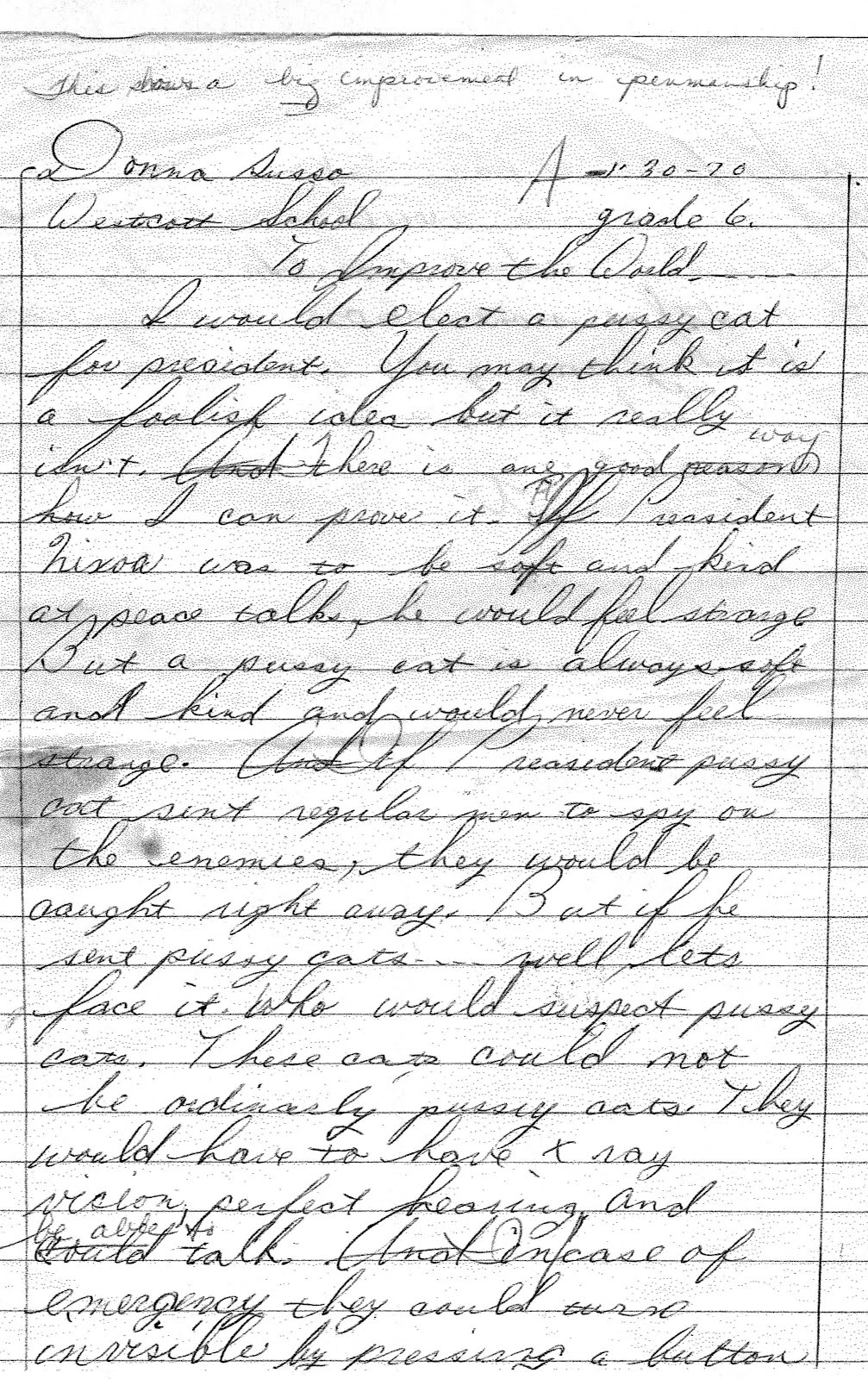
In a gesture of appreciation, I offer my first bestseller (according to Mrs. Alfonso’s sixth grade class).


Thursday, February 16, 2012

SURPRISE: PRESIDENTS’ DAY IS NOT ABOUT CAR SALES

On the heels of the throat gagging Valentine’s Day commercials, we now find ourselves in the throes of obnoxious car sales ads in honor of Presidents’ Day. Call me a Patriot (go ahead, I dare you), but I think we should actually celebrate the men for whom the day is meant to honor. Instead of a typical recital of what everyone SHOULD know about George Washington and Abraham Lincoln, I’d thought I’d offer some little facts as culled from a multitude of books on my “For Presidents Only” shelf.

George Washington was born on February 22, 1732. He became the first President of the United States and served from 1789 until 1797. He died on December 14, 1799. (As a personal piece of trivia, this particular portrait was rendered by Gilbert Stuart, a Rhode Islander such as myself, whose family's home is but a couple of miles from my own.)

George Washington is a joy of trivia and, as I read, revealed himself as someone who provides strong evidence that destiny exists. George came close to death no less than SEVEN times, all before the age of 30; the threats came from a myriad of sources…diseases, battle, and downright bizarre accidents. And yet, he survived, as if greater purposes awaited him.

When the Capitol was moved from New York to Philadelphia, Washington brought his slave, named Hercules, with him to serve as cook. He was, however, the only founding father to free his slaves.

Washington was the only president not to have served from Washington.

Under the heading of ridiculous, fun facts…at the moment of his inauguration, George possessed only one of his own teeth; he often wore dentures made of both human and animal choppers.

George Washington is the only president to be elected unanimously…electorally speaking.

And perhaps my favorite piece of trivia…as a farmer, Washington grew marijuana on his lands (for industrial purposes only, as hemp and soil stabilization…or so they say).

My favorite of George Washington quotes: “It’s wonderful what we can do if we’re always doing.”


Abraham Lincoln was born on February 12, 1809 and murdered by gunshot at the hands of John Wilkes Boothe on April 15, 1865. A ‘prairie lawyer’ who came to serve over one of the country’s most turbulent times, he proved himself to be a man of enormous conviction and a fanatical proponent of these United States. He is also considered one of the most popular presidents in the history of the nation, so there is a great deal known of him. Hopefully, a few of the following may take you by surprise.

Though Lincoln fathered four sons, there are no living descendants.

Standing behind the President on the day of his inauguration is none other than his assassin, John Wilkes Boothe (this one gives me the creeps).

Keeping in the realm of the creepy, Lincoln’s son Robert, who was in Washington when his father was killed, was at the scene when President Garfield was shot in 1881 and at the assassination of President McKinley in 1901.

A notoriously messy person, Lincoln kept an envelope on his desk at all times. On it, he had written, “When you can’t find it anywhere else, look into this.”

Lincoln was the first major leader to be a proponent of women’s suffrage, and as a State Legislator presented an Illinois paper in its support.

Abraham’s penchant for stovepipe top hats was more than aesthetic; he used it as a ‘purse’ of sorts, carrying in it such things as letters and money.

A very famous quote by Abraham Lincoln, one that should be taken up by every modern day politician, reads, “The time comes for every public man when it is best for him to keep his lips closed.”

For me, these are two men epitomize what a leader should be; there was very little personal gain in obtaining the Presidency in their times, except for the concept of egoic power, a smidgen of which I believe Washington possessed more than Lincoln. Instead, these men took up the reign for the true and sincere desire to serve their country, to devote their lives to a nation they loved. Indeed, worthy of a day of reflection and celebration.

Friday, February 10, 2012

VALENTINE'S DAY: AN HISTORICAL PERSPECTIVE

It is quite easy in these modern times to believe that Valentine’s Day is merely another overly commercialized, overly materialistic day for retailers to persuade us to part with money we don’t have in order to prove to another how much we may love them. (There’s some heavy cynicism for you if ever I heard any.) But as an author of historical fiction, I thought it prudent to take a look back to what began all this hoopla, that such a review might be beneficial in dispelling such skepticism. What I found was a plethora of theories, saints and martyrs, and as we’re dealing with an occurrence that began in ancient times, there is, of course, versions of both the Pagan and the Christian variety. And yet most of the stories speak of sacrifice and commitment of the heart till it stopped beating, possessing the ability to make even this disparaging heart utter a pathetic, ‘awwww.’

In ancient Rome, February 14th was a day set aside to honor Juno, known most frequently as the Queen of Gods and Goddesses, but also as the Goddesses of women and marriage. This theoretical genesis is also associated with the festival of Lupercalia, a series of holidays devoted to fertility and love. But to me there is nothing more to this theory than a figurehead for the loveless to prostrate themselves upon.

Then there are the martyrs. The Catholic Church formally recognizes three different saints by the nomenclature of Valentine. The most prevalent (and my personal favorite) is of a priest who lived during the third century, when Rome was ruled by the cruel Emperor Claudius II, a ruler who believed single men made better soldiers than those who were married (perhaps this is when the whole 'sex makes your legs weak' notion began) and therefore outlawed such couplings for those in his military. This particular Valentine refused to accept such a heartless contention and married love-struck soldiers in secret. In reward for his kindness, Father Valentine was apprehended on February 14, beaten to death with clubs and beheaded.

There are other stories of the same ilk, but they don’t seem to inspire quite the appropriate nuance of the holiday. To do so, I offer this theory.

There was a man by the name of Valentine, a man of kind heart and religious impartiality, who was incarcerated by the Pagans for helping Christians escape the harsh Roman prisons. While an outlandish hypothesis postulates that he performed a miracle and gave site to the warden’s daughter, the more easily believed theory was that he fell in love with her, spending much of his time in conversation with the girl as well as sending her many love letters, all of which he signed, “Your Valentine.”

The first reference to Valentine’s Day as we know it today, as a day to honor romantic love, comes from one of my idols, Geoffrey Chaucer, who wrote, “For this was on seynt Volantynys day, Whan euery bryd comyth there to chese his make.” ("For this was Saint Valentine's Day, when every bird cometh there to choose his mate.") And so was born a subject far too appealing for purveyors of the pen to ignore and was quickly the topic of many a prolific author, including Shakespeare and one duc d’Orleans.

In summation, the most certain conclusion I come away with on the genesis of Valentine’s Day is that it is as muddled as the concept of the emotion that it celebrates. But this I do know, yet I will not take credit for expressing it, but will use the words of my ‘first love’ (I was eight), I will use the words of John Lennon. Whether it be between a man and a woman, a man and a man, a woman and a woman, a parent and a child, a friend and a friend…"all you need is love."